 Coolant advantages Coolant advantages
The MID wet sleeve sits on a wide robust machined flange at the bottom of the coolant jacket. There is much less chance of the sleeve sinking into the aluminum than with a flanged dry liner that seats at the deck. The expansion rates of the sleeve and block are nearly identical because the sleeve takes the heat of combustion. At first glance one would expect the block to grow more but this not to be the case.


There are several coolant transfer slots milled horizontally between the siamesed walls of the MID sleeves to allow coolant flow and thermal transfer across the block and around the wet liner.
This prevents localised hot spots and in combination with the patented coolant groove at the very top of the bore (where the cylinder is hottest) greatly reduce the chances of detonation related engine failures. This really has to be a ‘must have’ for high power, blown or nitrous engines. The design of the MID sleeve provides superior cooling to the non-drilled siamesed LS2/7 block castings.

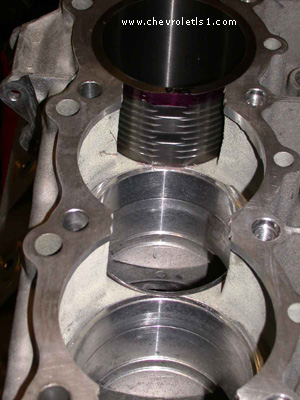
Note the patented coolant channel at the top of the liners where coolant flows along the block in the area above the piston ring lands. This cools the cylinder deck surface.
Darton recommend the use of a high performance Evans water pump which uses special Evans coolant that won’t cavitate. The stock LS1 pump with a stock thermostat flows appx 55 gpm. A Meziere electric pump flows appx 23 gpm. The Evans pump with Evans thermostat flows 85 gpm and with the Evans external outlet side thermostat flows 110 gpm. One gpm will cool roughly ten horsepower.
http://www.evanscooling.com/main13.htm
Click here to see the Evans pump tested:
 Corrected Darton LSA Flow Test (2 927KB) Corrected Darton LSA Flow Test (2 927KB)
|




 Site developed by Pixelmind.net